Total Pageviews

Monday, July 2, 2012

Beets and Canned Bluegill

I was delighted to see that my beets have actually developed roots this year. Last year the roots were tiny, and I had resigned myself to only getting beet greens.

I simply rinsed the beet root and simmered it in salted water for 45 minutes. After the root is cooked, the skin slides right off. The root was delightful as is and was even better drizzled with good olive oil and a dash of sea salt.

In other news, I came across a recipe for canning bluegills that eliminates the need to skin or bone, and lets you use even little fish.

Bayou Bill's Canned Bluegill Recipe

I love the idea of being able to preserve the fish like that, since there'll be winter days when fishing a fresh one won't be my idea of fun. These canned bluegill look like they'd be a bit like canned salmon, with the crunchy but edible bones.

Bayou Bill passed away in 2009, but I had a chat with his widow, Nancy. She'd be delighted to know folks are using Bill's recipes. Enjoy!

Friday, June 1, 2012

Footprints, Aquaponics, and "Being Green"

The conversation these days is full of talk returning to whole-grain foods and "being green." Yet it's not always clear what advertisers and green activists mean by "green." There are three different views of what "green" means:
  • Reducing our reliance on petrochemicals, our carbon footprint
  • Reducing our consumption of natural resources, our ecological footprint
  • Reducing our consumption of fresh water, our water footprint
Most folks focus simply on saving fossil fuel, the carbon footprint portion of the equation. This becomes contentious because reducing fuel use is often equated with changing existing market models. If you're in mixed company (e.g., liberals and conservatives) arguments will likely break out where those benefitting from the status quo and those advocating for change coming to near fisticuffs over the science behind "carbon footprint" and global warming. Typically proponents of the status quo claim "green" scientists and liberals are idiots. The UN target is ~2.0 metric tons of carbon per person per year. The current world-wide average is ~4.0 metric tons per year, and the average person in an industrialized nation produces more like 20.0 metric tons per year. Oops.

A more comprehensive measure is ecological footprint, how many "worlds" worth of earth's resources we consume, or how many "worlds" worth of earth's resources would be consumed if all earths inhabitants lived like us. The science behind ecological footprint isn't as likely to be challenged, because it is less well-understood. Besides, the slogan "Reduce, Reuse, Recycle" is pretty catchy and obvious. We are "sustainable" if we use only as many resources as the earth can renew in a single year. Currently humans worldwide consume resources it takes the earth 1.5 years to produce.

More recently the United Nations has begun focusing on water use. When it comes to water, there is no fossil fuel resource we can tap. The fresh water available is a finite resource, and mankind is not doing a good job of managing this resource. An old saying goes "Beer is for drinking, water is for fighting." Many of us forget that water is limited because all we have to do is turn a knob and water gushes forth. But lack of water is the natural "disaster" responsible for the greatest number of premature deaths across the globe.

When I grow food using aquaponics in my own backyard, I am arguably saving fuel relative to what I'd "spend" driving to the store. But as researchers have carefully measured and I've observed, aquaponics uses only 1/10th the water required for traditional gardens.

Aquaponics might not strike everyone as sustainable, since some of the components must use electricity or at least be made from relatively modern materials. However once you have your infrastructure in place, aquaponics is one of the most sustainable or "green" ways to grow food, particularly from the standpoint of saving water.

Wednesday, May 16, 2012

Aquaponics: Synergies with Other Topics

At left:

Example of a book you could look to for info on creating a 365 aquaponics system


I love aquaponics. But when you're looking to create your aquaponic garden, you can pull from numerous other resources. One of my favorite topics is year-round gardening.

I love the idea of being able to have vegetables (and fish...) during late fall, winter, and early spring. Most of the current aquaponics literature talks about growing in climates that are warm throughout much of the year, which makes it easy to have your fish and veggies year round. But what do you do when the temperature plummets to crazy low?

Last time I mentioned the Gaisma.com site. The interface is a bit clunky, but I love being able to look at climate information for any major city anywhere in the world. So if I'm reading a book written by Eliot Coleman of Four Season Farm, for example, I can look up his address in google maps, find the closest major city, and see what his climate is. In Eliot Coleman's case, that's either Augusta or Bangor, ME. If the lengths of his days and his temperatures are similar, I can have some confidence that the solutions he's developed can be applied to my situation.

On the other hand, if the person giving me advice on winter crops has their garden on the equator, I may want to be a bit more sceptical about whether the measures that work for them will be adequate for me.

PS - I haven't posted much lately for various reasons. But the most trivial reason for my silence is running up against my google.com storage limit. Getting me and my credit card and the website to buy more space together all at the same time wasn't working. Luckily for me, Google has shifted to their "Google Drive" concept, along with 5GB of free space (I think it was 1GB before). I'll still be absent a bit for the next few weeks for the other reasons I've been hiding. Towards the end of June, however, you can expect to hear from me more regularly.

Thursday, May 10, 2012

Urban Farming Guys in India


I woke up this morning to a cool e-mail from the Urban Farming Guys. They'd gone to India, to the isolated city of Imphāl, to install a barrelponics system for an orphanage.

The e-mail contained three videos. The first two minutes of the first video gives you a glimpse of the barrelponics design they were installing. Then next 30 minutes of video mostly gives you a sense of the beautiful people they were serving, and the primitive conditions with which they had to work.

UFG goes to India (14 min) : http://youtu.be/xSTh-UnuqgQ

part 2 (8 min) http://youtu.be/Zqgu5MfWEc0

part 3 (10 min) http://youtu.be/9A24Bbtjsdg

Thinking back, I initially didn't like the barrelponics system. The blue barrels and lack of aesthetics bothered me. But after over a year of trying to figure out elegant ways to create DIY systems one can create from local materials, the barrelponics concept is growing on me. And I think it would be possible to modify this system to make it less screamingly blue plastic DIY-ish. Anyway, check out at least the first couple of minutes of the Urban Farming Guys' video if you're just interested in plumbing ideas. The rest of the video is fun if you want to experience another world.

Another cool thing I discovered this week is the website Gaisma, where for any major city in the world you can find sunrise, sunset, and averages for the amount of sunlight ("insolation" in kWh/day taking into account weather and cloudcover), the amount of rainfall, windspeed, and temperature. For example, here is a portion of the Gaisma page for Imphāl.

At a glance you can see the amount of sun a location gets in each month of the year, the average monthly temperature, and the amount of rain (you can change the units if you're not used to the default measurements (e.g., inches of rain versus mm of rain)). Using Gaisma.com for my location, I was able to calculate the amount of rainfall I could expect per year on my greenhouse, in case I wanted to limit my rainwater harvesting to the relatively-clean plastic roof over my garden. In my case, it comes out to almost 2500 gallons per year for my little 8'x12' greenhouse. Crazy!

Saturday, April 21, 2012

Aquaponics Videos at PlanetStewards.com


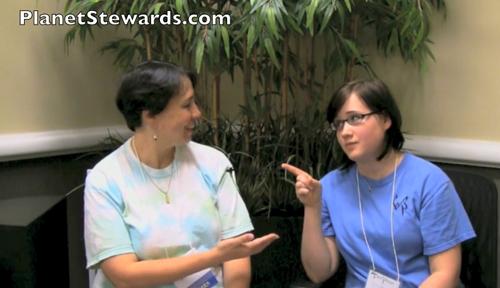
The Planet Stewards website went live a few days ago. And the free teaser (32 minutes worth) is the video they shot of me and my daughter, Tara Phillips, at the September 2011 Aquaponics Association Conference.

I remember being very happy and very tired that night. But it's fun remembering that weekend. I explain a bit why I started designing my own system (because I couldn't bear to pay for shipping for the systems then available) and some plumbing improvements I either discovered or imported.

Other videos from the conference are available for $20 apiece, if I recall correctly. Considering the price of air fare, hotel, and conference registration, that's a good deal (not to mention the fact that time travel to a past event would be prohibitive).

Visit PlanetStewards.com or click here to just watch the interview.

Sunday, March 11, 2012

Aquaponics at the Philadelphia Flower Show

A few weeks ago Sarah Gabriel e-mailed and asked if I wanted to do an aquaponics lecture at the Philadelphia Flower Show.

"Sure." I'm always up for doing something about aquaponics, but I had no idea what a huge event this is. The Philadelphia Horticultural Society is the oldest such society in America, formed in 1827. The Flower Show has been held annually since 1829 and is now the largest flower show in the world. Oh my goodness!

We were joined by Heidi Wood-Tucker who works with Dr. Stephen Hughes on the aquaponics program at Cheyney University. We had about 60 people attend our talk and demonstration. Heidi talked about the large aquaponics system they have at Cheyney, where they raise tilapia and grow basil - even using all their resources to produce basil, they are unable to satisfy the huge demand in this area. For my part, I put together a small demonstration system. I used the 10 gallon fish tank I'd gotten at PetSmart and a boot box from The Container Store, all on a wire rack from Target. In the process of preparing for this I made the awesome discovery that I could make my bell out of a glass jar as long as I propped it up a bit to allow water to flow underneath. It was fun getting to "see" how the bell siphon works!

I had a great time after the presentation wandering the show and talking to folks. I came home with lots of new friends, some nifty tools and gifts, and great ideas. Awesome!

Tuesday, February 14, 2012

The IBC of Aquaponics


Backyard Aquaponics has released an awesome manual on aquaponics, featuring 43 (yes, forty-three) systems made with Intermediate Bulk Containers or IBCs, appropriately called The IBC of Aquaponics. Even though I don't have an IBC system, I think IBCs are great. In fact, I'll be helping teach an aquaponics workshop in May where we'll be creating about a dozen IBC systems.

Why the IBC of Aquaponics is Cool - A list.
  1. The manual is free. That's always cool in my book.
  2. The introduction and appendix contain great (and pretty) information about aquaponics - all that stuff experienced aquapons have forgotten they ever had to learn.
  3. There are great pictures and write-ups on all the systems.
  4. Many of the articles about systems include hyperlinks to youtube videos, sketch-up models, and forum discussions about the systems.
Check out this cool chart, showing the relationship between nutrient availability and system pH. I've seen charts like this before and simplified the message in my own mind to "6.5 is good." But this version of the chart is absolutely lovely.

This level of professionalism and beauty continues through the rest of the document. If creating an aquaponics system out of an IBC tote appeals to you, you can browse several dozen different configurations, and even create a 3-D version of how your system could look (Google Sketch-up required).

If you live in the DC area and would like to participate in the May IBC workshop, drop me a line. Totes will be provided as part of the workshop!